Learn
The Phantom Golf Ball
By Mitchell ·
I spent part of a golf lesson teaching a 10-year-old how to miss the ball.
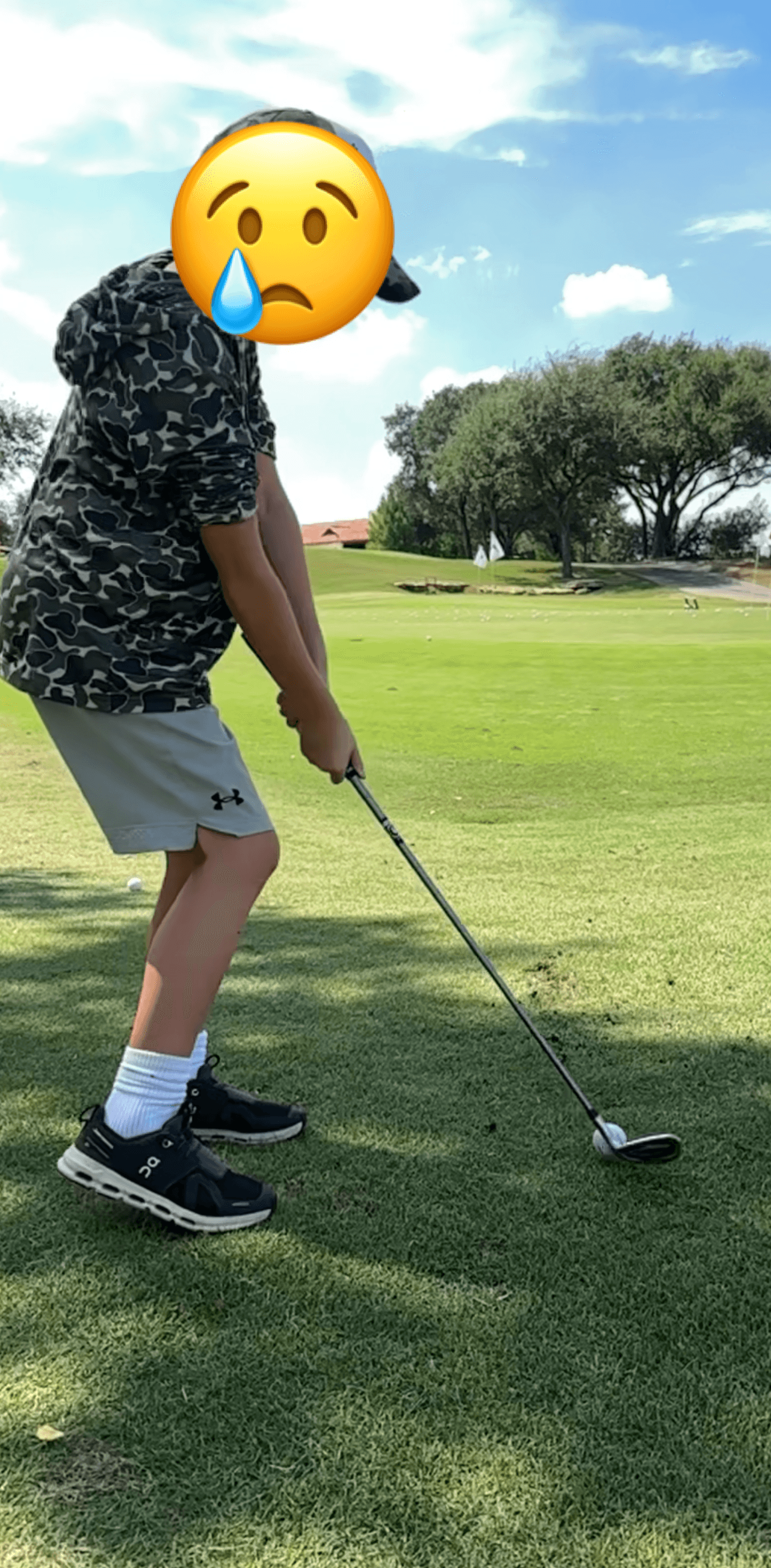
He was getting pretty good at hitting the wrong part of the club. Right off the hosel. Ball goes sideways. And don’t you dare say that word…
An inch and a half separated that shot from solid contact, and we needed a way for him to find it.
We started with some fairly straightforward adjustments. Feet closer together. Stand a little closer to the ball. Add a little wrist hinge in the backswing, then finish with some good arm structure.
These simple little changes in his motion were all fine and dandy to help this beginner junior on his way to better golf, but the most important work was still to be done.
We needed to change his impact point on the clubface to get a result that even slightly resembled a golf shot.
Like I said, we’re only talking about moving the impact point by an inch or so, but that’s the difference between a squirrelly shank and a solid shot that gets this young man on the green!
His inside takeaway was so flat it might make you think of a merry-go-round. From there, the poor kid would either bounce the club into impact or keep the club above the ground long enough to thrust the hosel into the ball.
I told him to think of his motion more like a Ferris wheel: more up and down as the club moved back and through. While he made some good practice swings that bruised the turf in the correct spot without the clubhead thrusting away from him, he just couldn’t replicate that same motion when it came time to hit the ball.
I was flustered. Poor kid was hitting it like crap. And it’s about 105 degrees down here in Texas in the midafternoon. It took us a little while, but then we finally made a breakthrough.
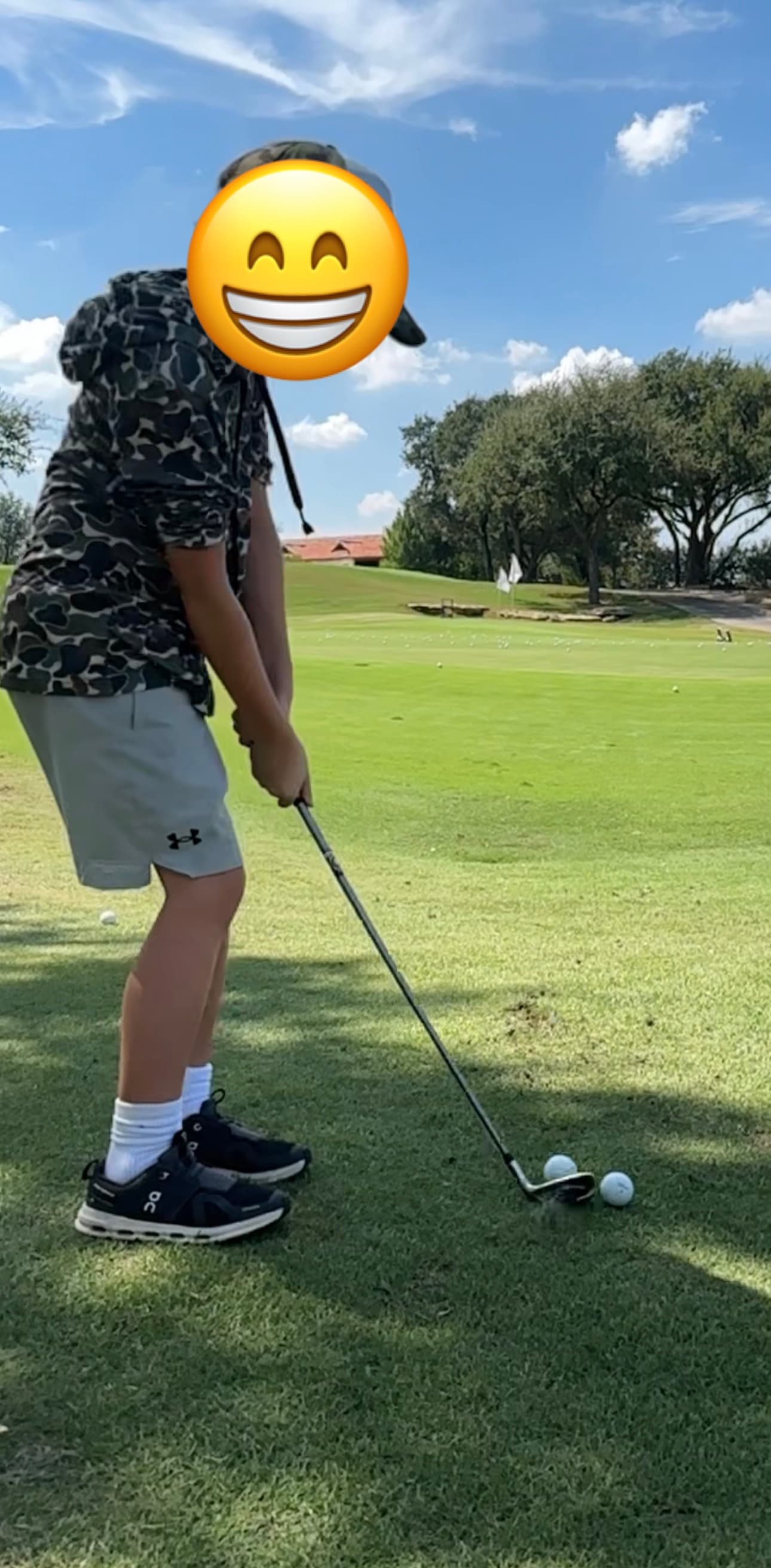
I put another golf ball just outside the one he was lining up to hit and told him two things:
Hit the inside ball. Miss the outside ball.
If the club thrusted away from him like it had been, we were gonna have two clankers rolling off to the right.
The first attempt was good: he missed the outside ball but caught the intended ball thin. The clubhead was now CLOSER to him at impact, but a touch too high. After a couple of practice swings with an intention of brushing some grass, he squared one up in the middle of the face, missing the outside ball. That US Kids Golf PW sent that ball 20 yards in the air and right on the green.
They grow up so fast.
In the before picture, you can see the ball contacting the hosel. In the after picture, you can see the extra ball sitting outside the one he was hitting, with the impact point closer to the center of the face.
There was no more talk of amusement park rides or structured arms. He just needed to miss the outside ball.
In motor-learning research, that instruction fits what’s called a proximal external focus of attention.
“External” means his attention was on what the club needed to do in relation to something outside his body. “Proximal” means that something was nearby, which was down on the ground right in front of him.
That terminology describes the learning science. For him, the instruction was four words: miss the outside ball.
I could explain the mechanics of this hosel rocket until the cows came home and accurately describe and demonstrate the motion I wanted him to make. But what he really needed was a specific task that didn’t require him to consciously organize several body movements at once. He could see the obstacle, swing, and find out whether he was successful.
The second ball gave us feedback. If he hit both balls, we knew the club had thrusted too far away from him coming into impact. If he missed the outside ball, we knew that impact point was now actually on the face.
Of course, we didn’t suddenly hit every shot perfectly. The outside ball still took some abuse. We even negotiated a gentlemen’s bet around whether he could miss it.
Then we took the outside ball away.
Same deal, just missing the imaginary outside ball.
That became the Phantom Golf Ball.
So he could picture that same ball on the outside and do his best to avoid it!
To test how this would hold up on the course, we had an up-and-down competition to add a little pressure and see if the skill stuck.
Next ball. Shank.
So then I had him get his feet set, look at his ball, and say it.
“Phantom Golf Ball.”
Then swing.
His next shot popped up in the air to about 10 feet from the hole. Still skeptical, I had him hit another saying “Phantom Golf Ball” before he started his swing just to make sure it wasn’t just luck. Five feet from the hole.
“One is an occurrence, two’s a pattern.”
A little optimistic after two shots? Sure. Two good shots don’t tell us whether he’ll still have it next week. They did show us that he could use the intention without the second ball physically sitting there.
The Phantom Golf Ball gave him a way to take that skill onto the course.
Picture the outside ball.
And try like hell to miss it.
Explore my coaching approach or view golf lesson and club fitting services and rates at UT Golf Club in Austin.
Keep learning
Golf ideas you can use
Real lesson stories and practical explanations to help you understand your game, find your path to lower scores, and make better decisions about your golf game.